Understanding GSM: The Global Standard for Mobile Communications
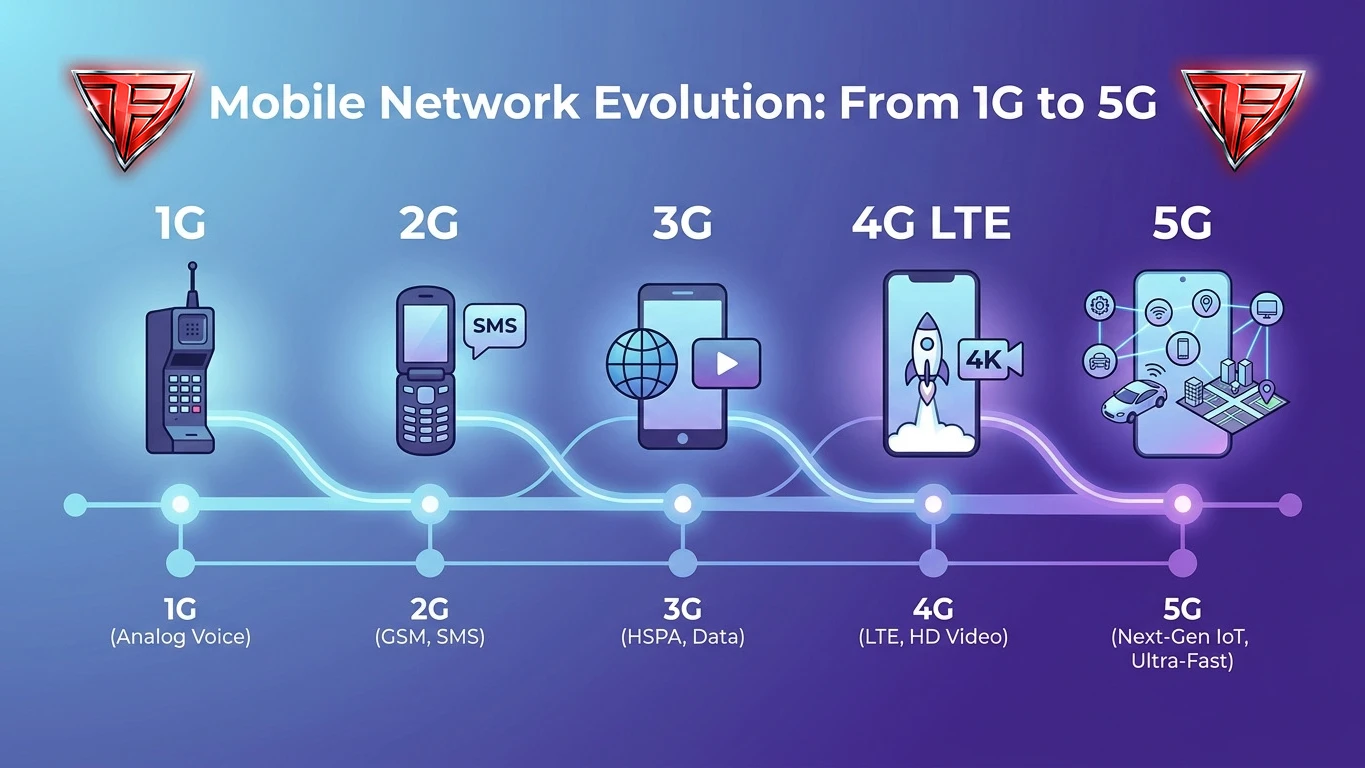
The Global System for Mobile Communications (GSM) is the standard that defined the second generation (2G) of digital cellular networks. Launched in Finland in 1991, it revolutionized the world by moving mobile telephony from analog signals to digital ones, enabling not just clearer voice calls, but also the ability to send text messages (SMS).
Today, while 4G and 5G dominate, GSM remains the foundational "fallback" network in many parts of the world, ensuring that basic communication remains possible even in remote areas.
The Architecture of GSM
GSM operates on a cellular network, meaning mobile phones connect to it by searching for cells in the immediate vicinity. A GSM network is divided into four major sections:
Mobile Station (MS): Your mobile phone and the SIM (Subscriber Identity Module) card.
Base Station Subsystem (BSS): The towers and controllers (BTS and BSC) that handle radio traffic.
Network and Switching Subsystem (NSS): The "brain" of the network that handles call routing, SMS, and user authentication.
OSS (Operation and Support Subsystem): The portion used to manage and monitor the entire network.
The "Quad-Band" Standard: GSM Frequency Bands
GSM uses a technology called TDMA (Time Division Multiple Access) to allow multiple users to share the same frequency channel. The system operates in different frequency bands depending on the region. The four most common bands are known as "Quad-Band GSM."
1. GSM 850 (The Americas)
Frequency Range: 824–849 MHz (Uplink) / 869–894 MHz (Downlink).
Usage: Primarily used in North America and parts of South America. Lower frequencies like 850 MHz provide excellent coverage over long distances and penetrate buildings effectively.
2. GSM 900 (Europe, Asia, Africa, Oceania) (P-GSM / E-GSM / R-GSM)
Range: ~880–960 MHz
Region: Europe, Asia (including India), Africa, Middle East
Variants:
P-GSM (Primary GSM 900)
E-GSM (Extended GSM 900)
R-GSM (Railway GSM)
ER-GSM (Extended Railway GSM)
Use case: Best coverage + penetration (buildings, rural zones)
Overview: The most widely deployed GSM band globally.
3. GSM 1800 / DCS 1800 (Europe, Asia, Africa)
Frequency Range: 1710–1785 MHz (Uplink) / 1805–1880 MHz (Downlink).
Usage: Often referred to as DCS (Digital Cellular Service). Because it operates at a higher frequency, it has a shorter range than GSM 900 but can handle more simultaneous callers. It is commonly used in densely populated urban areas.
4. GSM 1900 / PCS 1900 (The Americas)
Frequency Range: 1850–1910 MHz (Uplink) / 1930–1990 MHz (Downlink).
Usage: Often called PCS (Personal Communications Service). This is the high-frequency counterpart to GSM 850 used in North and South America to increase network capacity in cities.
Complete GSM Band List (Standardized)
According to GSM/3GPP band definitions, the full GSM band set includes:
T-GSM 380
T-GSM 410
GSM 450
GSM 480
GSM 710
GSM 750
T-GSM 810
GSM 850
P-GSM 900
E-GSM 900
R-GSM 900
ER-GSM 900
DCS 1800
PCS 1900
Key Features of GSM Technology
SIM Cards: GSM introduced the SIM card, allowing users to move their identity, contacts, and phone number between different handsets easily.
Short Message Service (SMS): GSM was the first standard to support text messaging.
International Roaming: Because GSM is a unified global standard, it allowed users to take their phones abroad and use them on foreign networks for the first time.
Security: By using digital encryption between the mobile station and the base station, GSM offered significantly more privacy than the analog networks that preceded it.
The Legacy of GSM
While we have moved into the era of 5G, the concepts introduced by GSM—such as global roaming, SIM cards, and digital encryption—remain the backbone of how we communicate today. Many countries are currently "refarming" these GSM frequencies to use them for more efficient 4G and 5G signals, but the "Quad-Band" phone remains a symbol of the first truly global mobile revolution.