
🔹 What is HSDPA?
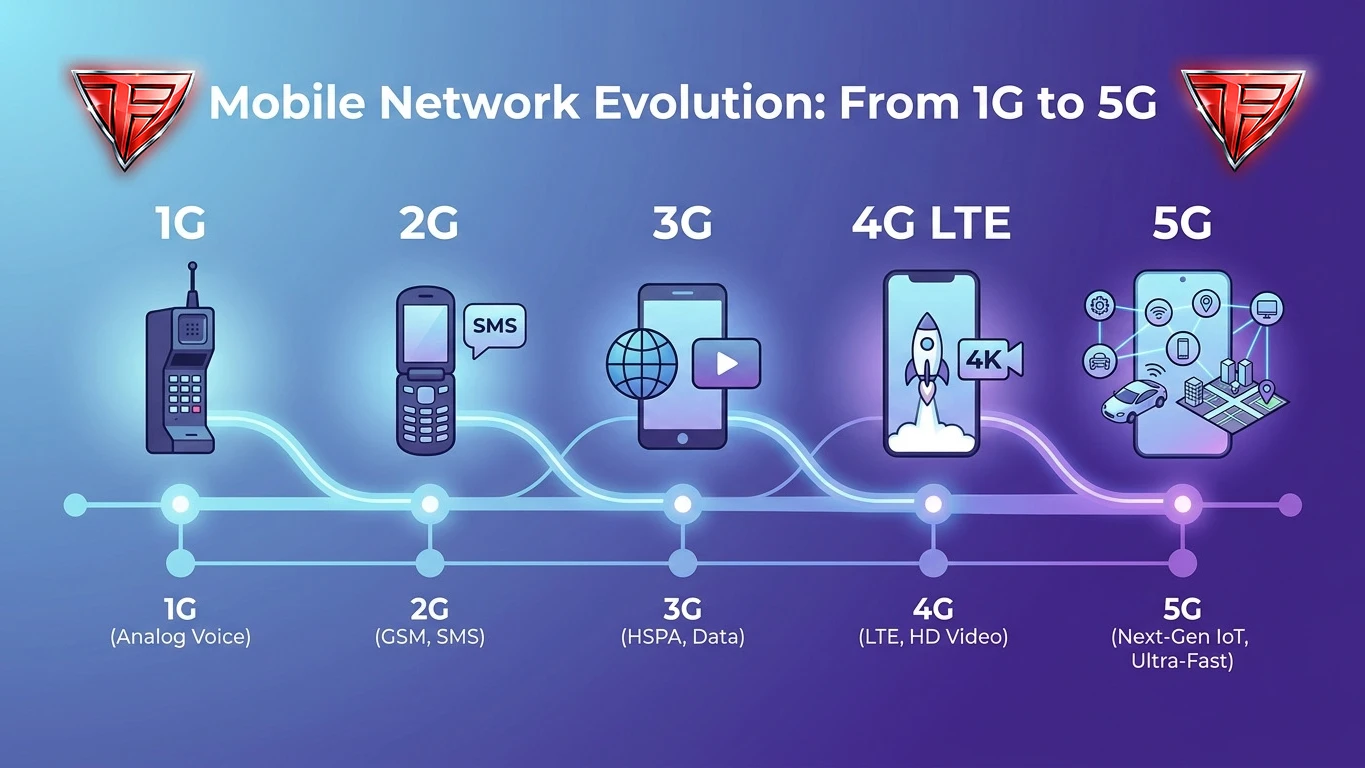
HSDPA (High-Speed Downlink Packet Access) is an enhancement of the 3G UMTS (Universal Mobile Telecommunications System) standard, often referred to as 3.5G. Because different parts of the world historically used different radio frequencies for cellular service, HSDPA is deployed across a variety of frequency "bands."
Understanding these bands is crucial for ensuring device compatibility when traveling or purchasing hardware.
📶 Based on UMTS (Universal Mobile Telecommunications System)
⚡ Download speeds up to 14.4 Mbps (theoretical)
📡 Works on specific frequency bands worldwide
Global 3G HSDPA Frequency Bands
The 3GPP (3rd Generation Partnership Project) standardized several bands. The most common are Band .
1. HSDPA 2100 MHz (Band I)
This is the "Universal" 3G band. It was the first spectrum allocated specifically for 3G services globally.
Definition: High-frequency band ideal for high-density urban areas.
Characteristics: Provides excellent data speeds but has a shorter range and struggles to penetrate thick walls compared to lower frequencies.
Usage: If a phone is "Global 3G," it must support 2100 MHz.
2. HSDPA 1900 MHz (Band II)
Known as the PCS (Personal Communications Service) band.
Definition: A high-frequency band used primarily in the Western Hemisphere.
Characteristics: Similar to the 2100 MHz band in performance. It was "refarmed" from older 2G digital services to support 3G HSDPA.
Usage: Dominant in the USA, Canada, and parts of Latin America.
3. HSDPA 1700/2100 MHz (Band IV / AWS)
This is a split-frequency band called AWS (Advanced Wireless Services).
Definition: It uses 1700 MHz for the "Uplink" (sending data) and 2100 MHz for the "Downlink" (receiving data).
Characteristics: Unique because it requires a specific radio antenna that can handle two different frequencies simultaneously for a single connection.
Usage: Primarily used by T-Mobile in the USA and various carriers in Canada and Chile.
4. HSDPA 850 MHz (Band V)
Often called the Cellular or CLR band.
Definition: A low-frequency band originally used for the very first analog cell phones.
Characteristics: Excellent "propagation." The signal travels long distances and easily passes through buildings and forests. This makes it the "Gold Standard" for rural coverage.
Usage: Widely used in the USA (AT&T), Australia (Telstra), and many parts of Asia and South America.
5. HSDPA 900 MHz (Band VIII)
This band was created by "Refarming" the original 2G GSM 900 spectrum.
Definition: A low-frequency band used as an alternative to 850 MHz in regions where 850 MHz was not available.
Characteristics: Like the 850 MHz band, it offers superior range and indoor penetration. It allowed operators in Europe and Asia to provide 3G coverage in rural areas without building thousands of new cell towers.
Usage: Common in Europe, New Zealand, and parts of Asia and Africa.
| Summary Table | ||||
| Band 5 | 850 MHz | Low | Very Wide | Americas, Australia |
| Band 8 | 900 MHz | Low | Wide | Europe, Asia, India |
| Band 1 | 2100 MHz | High | Medium | Global |
| Band 2 | 1900 MHz | Mid | Medium | North America |
| Band 4 | AWS | Mid/High | Medium | USA, Canada |
| Band 6 | 800 MHz | Low | Wide | Japan |
| Band 9 | 1700 MHz | Mid | Medium | Japan |
| Band 19 | 800 MHz | Low | Wide | Japan |

Why Do Band Names Matter?
When you see a phone spec list like HSDPA 850 / 900 / 1900 / 2100, it means the device is a "Penta-band" or "Quad-band" 3G phone.
Global Roaming: A phone supporting 900/2100 will work in most of the world but will fail or revert to slow 2G speeds in the USA.
In-Building Coverage: If your carrier uses 2100 MHz, you might lose signal inside a basement. If they use 850 MHz, you are more likely to stay connected.
Note: As of 2026, many carriers worldwide have begun "sunsetting" (turning off) 3G HSDPA networks to reuse the spectrum for 4G LTE and 5G. Always check if 3G is still active in your specific region.


No reviews yet. Be the first to review!